


Stephen Crafti, architectural journalist and writer, said; "When architect Danny Broe first inspected this property, there was little remaining of the Victorian duplex – with a 1940s façade removing any vestige of the past. If that was the only problem, maybe a renovation could have occurred. But sadly, the house was riddled with asbestos along with other issues that made it unfit for a couple looking for a family home.
Located in a heritage precinct, with a combination of two-storey terraces and cottages, the direction taken by Danny Broe and his team was to respect the setting while still allowing for a contemporary abode. Taking their cue from a neighbouring house, with dormerwindows typical of the Victorian period, the new house presents to the street as a traditional period home, complete with a slate roof, a wrought iron balustrade and French- style doors leading to the front terrace. While some, if not most, architects would steer away from reproducing the past, here, both the architects as well as their clients, were ‘on the same page’. As with Victorian houses, it is solid brick with timber-framed doors, rather than aluminium as used today. The house was also built used traditional methods rather than simply engaging with new ‘tricks of the trade’ (read ‘cheap’ and relatively quick to create).


Benefiting from dual access from the rear, the idea of creating the past could be more easily achieved – with a double garage from the rear street also benefiting from a large dormer window, but clad in zinc and offering a more contemporary interpretation of the past. As the site benefits from being a double block, there was also greater opportunity to provide a large contemporary home, approximately 350 square metres in area. And as there’s a modest fall to the rear (approximately 1.5 metres), it was possible to include a third level.


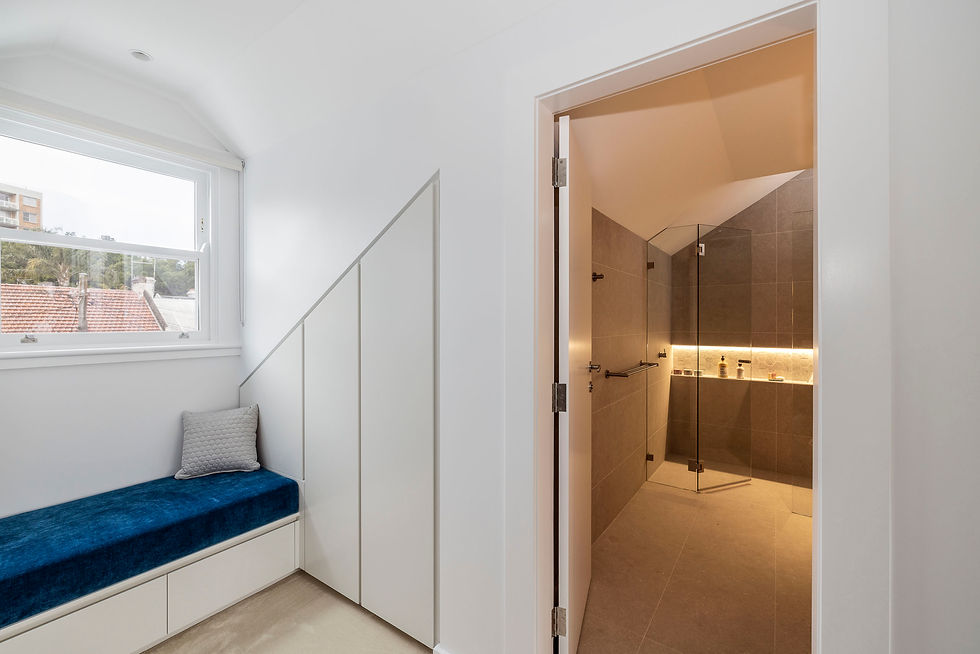
Broe literally created a contemporary canvas behind the traditional façade but paid homageto the Victorian period by including two front rooms that have the scale and proportionsfound in many period homes – one now used as a formal sitting area, the other as a guestbedroom with an ensuite. However, beyond these two rooms, the format is sharper and contemporary, with the L-shaped floorplan including a light-filled kitchen, dining and livingarea that’s connected to the northern garden. A double-height void in the living area furtheraccentuates the sense of space. In the mix are a series of spaces or nooks that create ‘roomswithin a room’, such as the whimsical dark navy angular ‘cave’ used by the children as aplace for quiet time. While the house appears traditional from the street, with manyexpecting a shotgun-style corridor, here’s there’s a sense of playfulness that responds to theway a young family lives today.
Text by Stephen Crafti




before


after
THE TEAM
As usual we couldn't have done it without the collaboration with the entire highly skilled team and the clients. This includes:
Principal Architect - Danny Broe
Architect - Design stage - Danny Broe Architect
Interior Designer - Veronica Andrus - Blaskievics (Danny Broe Architect interior designer)
Town planner - Navon Planning - http://www.navonplanning.com.au/
Heritage Consultant - John Oultram Heritage & Design
Structural Engineer - Harrison & Morris Consultancy - https://harrisonmorris.com.au/
Hydraulic Engineer - Harrison & Morris Consultancy - https://harrisonmorris.com.au/
Joiner - CRS Joinery - https://www.crsjoinery.com/
Builder - AS & KB Constructions - https://www.askbconstructions.com.au/
Photographer - Karina Illovska - http://www.karinaillovska.com.au/
Location:
Bondi Junction
Existing House Type:
Two Semi detached cottages
Floor Area:
372m2


